VPN technologies explained in simple terms
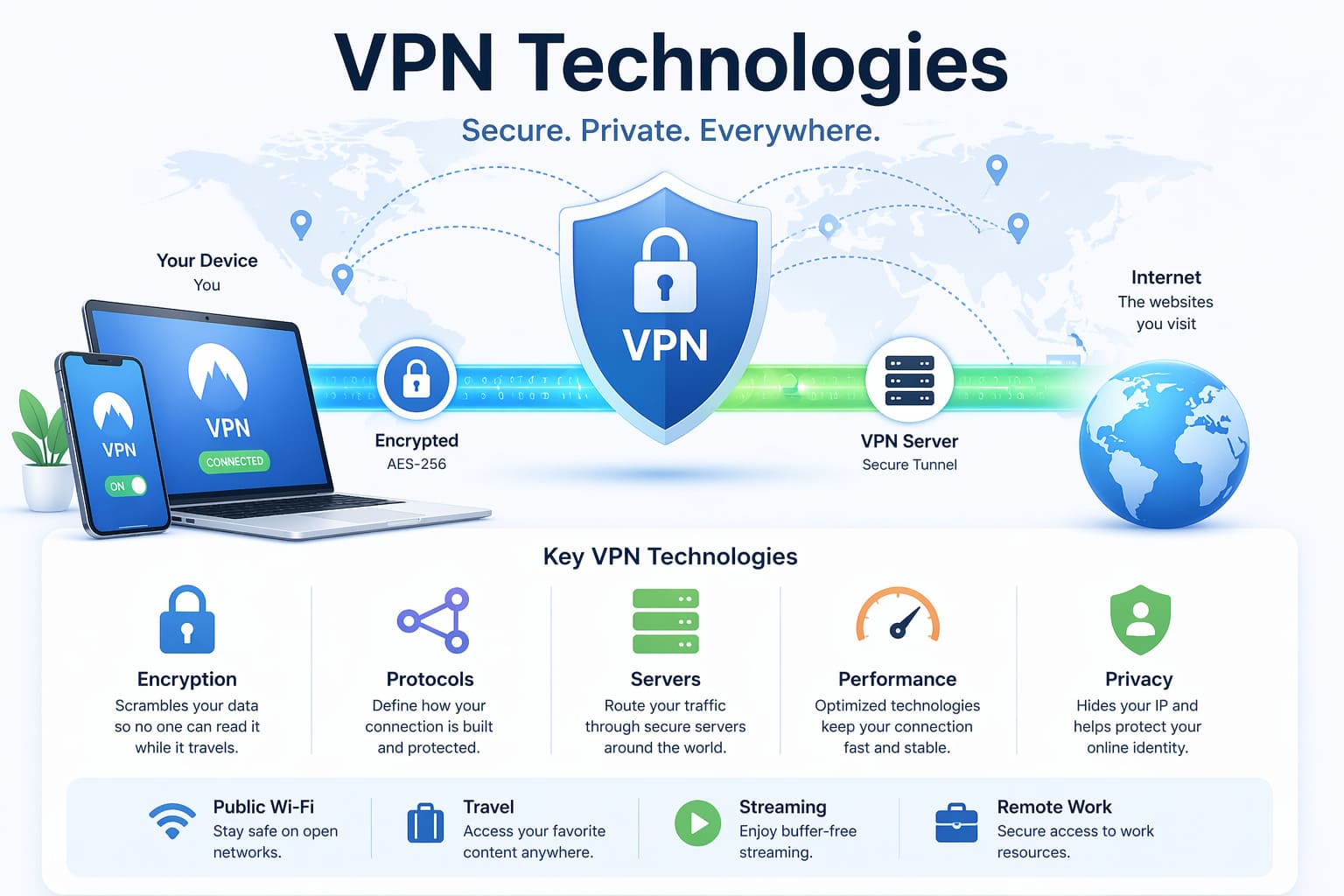
When people try to understand vpn technologies, they usually expect something complicated. In reality, everything works much проще, чем кажется. You don’t need to learn technical terms to see the effect — you just need to know what changes when a VPN is active.
A VPN is not a single feature or button. It’s a system made up of several technologies that work together. These elements handle your data, redirect your connection, and protect your activity — all at the same time.
Instead of focusing on how it’s built, it’s more useful to look at what it actually does: it limits exposure, adds protection, and gives you more control over your online presence.
What actually changes when technologies VPN are active
Before diving into specific components, it’s important to understand how things behave differently once a VPN is turned on. Most of the changes happen instantly and without visible signs.
Here’s what shifts in real use:
- Your internet traffic no longer travels directly.
- Your identity becomes less visible online.
- Your connection gains an additional protection layer.
For example, when you open a website without a VPN, your request goes straight from your device to the server. With technologies VPN enabled, that path changes completely — your data is first processed, secured, and then forwarded.
This is especially noticeable in places like cafés, hotels, or airports, where unsecured networks are common.
👉 Tip: Activate your VPN before opening any apps that involve logins or personal data.
Why encryption is the foundation of technologies VPN
At the center of everything is encryption. Without it, a VPN would only change your location, but your data would remain readable.
Encryption transforms your information into a format that cannot be understood without a key. This process happens in milliseconds, but it changes everything about how your data travels.
In modern VPN systems, AES-256 encryption is widely used. It’s considered extremely secure and is applied in financial and government environments.
Here’s what it practically means:
- 🔐 Your data becomes unreadable during transmission
- 📡 Interception attempts become useless
- 💳 Sensitive actions stay protected
Even if someone manages to access your connection, they won’t be able to extract meaningful information.
Protocols: how technologies VPN manage your connection
Encryption alone doesn’t define how well a VPN works. The way your data is transferred also plays a major role. This is handled by protocols.
Protocols decide how your connection is created, maintained, and optimized. Each one focuses on a different balance between speed and security.
Today, the most common options include:
- WireGuard → known for speed and efficiency.
- OpenVPN → trusted for strong security.
- IKEv2 → optimized for mobile stability.
These are not just technical differences — they affect your real experience.
For instance:
- Faster protocols improve streaming and browsing
- More secure ones are better for public networks
👉 Tip: Switching protocols inside your VPN app can noticeably change performance.
Server networks and how they affect your experience
Another key part of vpn technologies is the server infrastructure. This is what allows your connection to appear from a different location and stay stable.
When you connect, your traffic passes through one of these servers before reaching its destination. The quality of this network directly impacts how your VPN feels.
Important factors include:
- 🌍 Number of available locations
- ⚡ Distance between you and the server
- 📡 Server load and capacity
In 2026, top providers operate between 3,000 and 7,000 servers globally. This scale allows better distribution of traffic and reduces slowdowns.
Why this matters:
- More servers → less congestion
- Closer servers → faster response time
- Wider coverage → better access worldwide
👉 Tip: For daily use, select the nearest server for the best balance.
How technologies VPN fit into everyday situations
Understanding technologies VPN becomes much easier when you connect them to real scenarios instead of theory.
Here’s how they help in practice:
☕ Public Wi-Fi
Prevents others on the same network from accessing your data
🌍 Travel
Keeps access to familiar services stable across countries
🎬 Streaming
Maintains connection reliability while switching regions
💻 Work
Protects login credentials and internal tools
Recent data from 2026 shows that more than 65% of users connect to open or shared networks at least once a week. That’s where technologies VPN provide the most visible benefit.
Performance: what actually happens to your speed
A common concern is whether a VPN slows everything down. The short answer — slightly, but not in a way most users notice.
Current averages show:
- Speed drop between 10% and 20%
- Stable video playback in most cases
- Minimal impact on browsing
Interestingly, some users experience more stable connections because VPN routing can avoid inefficient paths used by internet providers.
So while there is an extra step in the process, modern systems handle it efficiently.
Mistakes that reduce the effectiveness of VPN technologies
Even strong tools can fail if used incorrectly. Many users unintentionally weaken their own protection.
Typical issues include:
- Starting VPN after connecting to networks
- Choosing distant servers without a reason
- Ignoring disconnections
- Using unknown or suspicious apps
👉 Tip: Enable automatic connection to ensure continuous protection.
Small habits like this significantly improve results.
How to recognize effective technologies VPN
Not all VPN services offer the same quality. The difference lies in how well the technologies are implemented.
When choosing a service, focus on:
- ✔ Reliable encryption standards
- ✔ Modern connection protocols
- ✔ Strong global server network
- ✔ Consistent performance
- ✔ Transparent provider policies
At the same time, be cautious of services that:
- ❌ Avoid explaining how they operate
- ❌ Promise unlimited features for free
- ❌ Show inconsistent performance
👉 Tip: Testing in real conditions reveals more than any specification list.
VPN technologies in real life
At a practical level, vpn technologies are not about complexity — they are about reducing risk.
You don’t need to understand every detail to benefit from them. What matters is how they change your everyday internet use.
With the right setup, you get:
- safer connections
- more consistent performance
- less tracking
- better data control
👉 The simplest way to understand the impact is to use a VPN in a real situation — especially on public Wi-Fi. Once you experience the difference, it becomes part of your normal routine.