What is a VPN provider
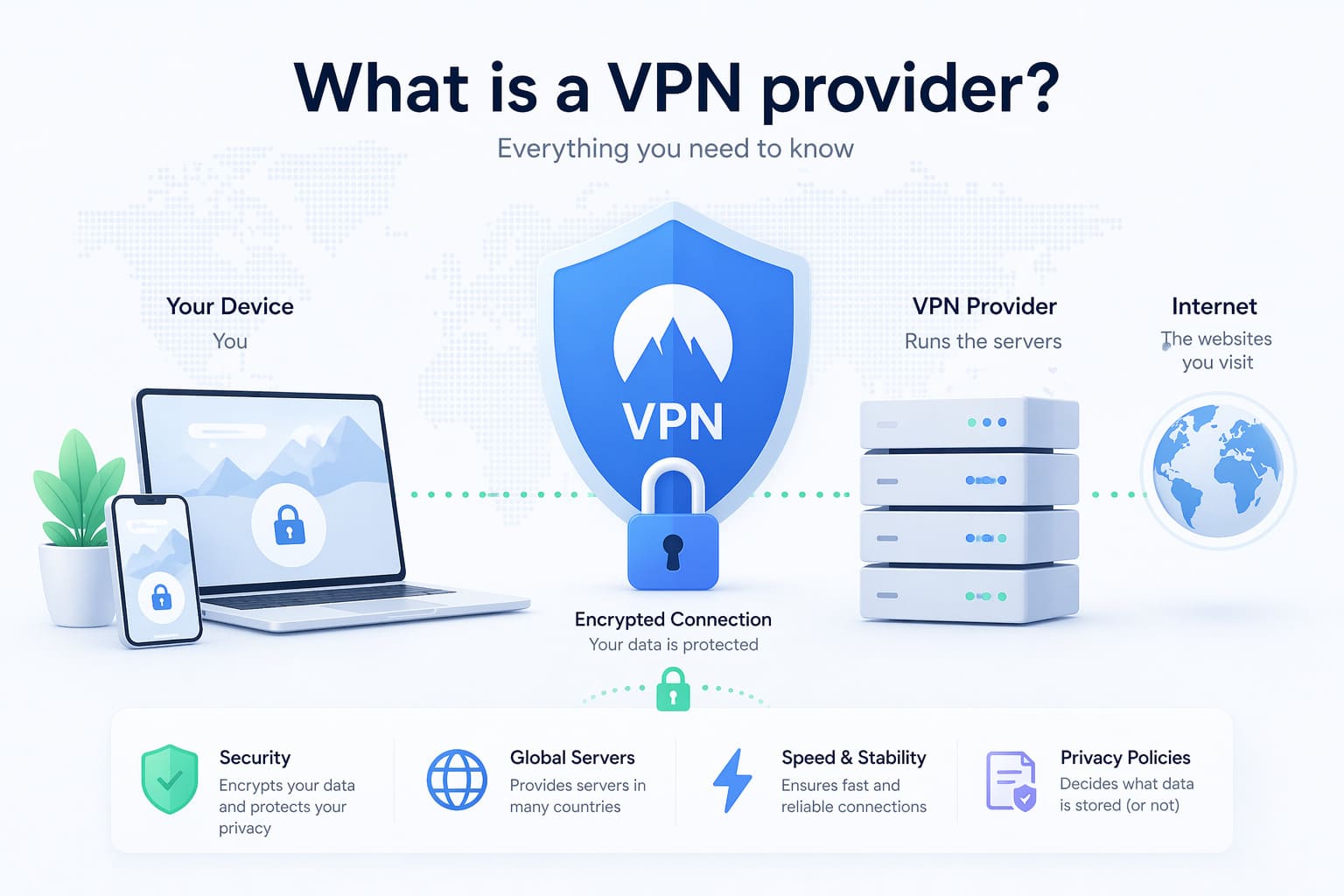
When people search what is a vpn provider, they usually don’t want technical definitions — they want to understand who controls the service and why that affects their safety. A VPN works as a technology, but the real performance and safety depend on the company operating it.
Think of it this way: using a VPN without understanding the provider is like using a bank without knowing who owns it. Everything may seem fine — until it isn’t.
What a VPN provider actually does
Before going deeper, it helps to clarify the basics. A VPN provider is the organization that runs the infrastructure — including servers and systems — that handles your encrypted connection.
Once you activate a VPN connection:
- Your internet requests are routed through remote servers
- Your real IP gets substituted with another location
- Your traffic is encoded before leaving your device
As a result, the provider manages how your connection behaves from start to finish.
In simple terms, they are responsible for:
- 🔐 Security of your data
- 🌍 Server locations worldwide
- ⚡ Connection speed and stability
- 📡 Privacy policies and data handling
So the VPN app you install is just the surface. The provider is the system behind it.
Why the provider matters more than the VPN itself
It’s easy to assume all VPNs work the same way. They don’t. The provider determines how well everything functions in real life.
For example:
- A weak provider may log your activity.
- A slow network can ruin streaming or browsing.
- Poor infrastructure leads to frequent disconnects.
According to industry reports in 2026, over 35% of free VPN apps collect user data, even though they claim to protect privacy.
That’s why asking what is a vpn provider is not just a technical question — it’s a security decision.
What is a VPN provider and how it works
Now let’s look at what actually happens behind the scenes. When you connect, the provider creates a secure path between your device and the internet.
Here’s what changes:
- Your real IP address becomes hidden.
- Your data is encrypted (usually AES-256).
- Websites see the provider’s server, not you.
Because of this, tracking becomes much harder. However, there is one important detail:
👉 The provider can technically see your traffic — unless they follow strict no-logs policies.
That’s why trust matters more than features.
Types of VPN providers you’ll find
Not all providers operate the same way. Understanding the differences helps you avoid common mistakes.
Free VPN providers
- Limited servers
- Slower speeds
- Often supported by ads or data collection
Paid VPN providers
- Better infrastructure
- Stable connection
- Strong privacy policies
Specialized providers
- Focus on streaming
- Optimized for gaming
- Built for business use
👉 Tip: If a service is completely free, ask how it makes money. That usually reveals the real trade-off.
Real situations where a VPN provider matters
Instead of theory, let’s look at everyday use.
☕ Public Wi-Fi
Without a reliable provider, your connection can still be exposed. A strong VPN service protects your data instantly.
🌍 Traveling
Accessing accounts from another country can trigger security blocks. A good provider offers stable regional servers.
🎬 Streaming
Some providers maintain servers that work smoothly with streaming platforms, while others fail constantly.
💻 Remote work
Secure access to accounts and tools depends on connection stability — something only strong providers deliver.
How to choose a trustworthy VPN provider
Choosing the right provider doesn’t have to be complicated. Focus on a few key factors instead of marketing promises.
Look for:
- ✔ No-logs policy (clearly stated)
- ✔ Large server network (50+ countries)
- ✔ Stable speeds (minimal drops)
- ✔ Transparent company background
- ✔ Regular updates and support
Avoid:
- ❌ Unknown apps with no company info
- ❌ Unrealistic “100% free unlimited VPN” claims
- ❌ Services that request unnecessary permissions
👉 Tip: Check reviews based on real usage, not just ratings in app stores.
How to test a VPN provider before trusting it
Before you fully rely on a service, it’s worth checking how it performs in real conditions. Reading promises is one thing, but testing gives you actual answers.
Start with a few simple checks:
- 🔍 Compare your IP before and after connecting
- ⚡ Run a speed test (normal vs VPN connection)
- 🌐 Switch between 2–3 server locations
- 🔐 Check for DNS or IP leaks
👉 Tip: If your IP stays hidden and speed drops less than 20%, the provider is doing its job properly.
Even a 5-minute test can reveal more than any review.
VPN provider vs VPN app: what’s the difference
Many users confuse these two concepts, but they are not the same. Understanding this helps you avoid a common mistake.
A VPN app is just the interface you use — the button you press to connect.
A VPN provider is everything behind it:
- Servers
- Infrastructure
- Security system
- Data policies
So even if two apps look similar, the experience can be completely different depending on the provider.
👉 In simple terms:
App = what you see
Provider = what actually protects you
Real numbers that show how VPN providers differ
To better understand what is a vpn provider, it helps to look at real metrics. Not all services operate at the same level.
Typical differences between providers in 2026:
- 🌍 Server coverage: from 20 to 60+ countries
- 📡 Total servers: from 500 to 5000+
- ⚡ Speed loss: 10–20% (good providers) vs 40%+ (weak ones)
- 🔐 Encryption: AES-256 is the standard for reliable services
These numbers directly affect your experience.
For example:
- More servers = better speed and less overload
- Wider coverage = more stable access when traveling
- Lower speed loss = smoother streaming and browsing
👉 Tip: If a provider doesn’t share basic stats, that’s usually a red flag.
Even with all these factors, many users still misunderstand how providers work.
Common misconceptions about VPN providers
Many users misunderstand how providers work. Let’s clear up a few things.
“All VPN providers are the same.”
No — infrastructure and policies vary significantly.
“Free VPNs are safe enough.”
Sometimes, but many trade privacy for profit.
“A VPN guarantees full anonymity.”
Not entirely — it reduces exposure, but doesn’t make you invisible.
What is a VPN provider in real life
In real-world use, understanding what is a vpn provider comes down to a single factor — trust.
You’re not just using an app. You’re routing your internet activity through a system managed by someone else.
A good provider gives you:
- Safer browsing
- Stable connection
- Better control over your data
A bad one can do the opposite.
👉 The most effective way to evaluate a provider is to test it in real situations — public Wi-Fi, streaming, and daily browsing. This is when the difference becomes clearly noticeable.