What is a VPN vs proxy
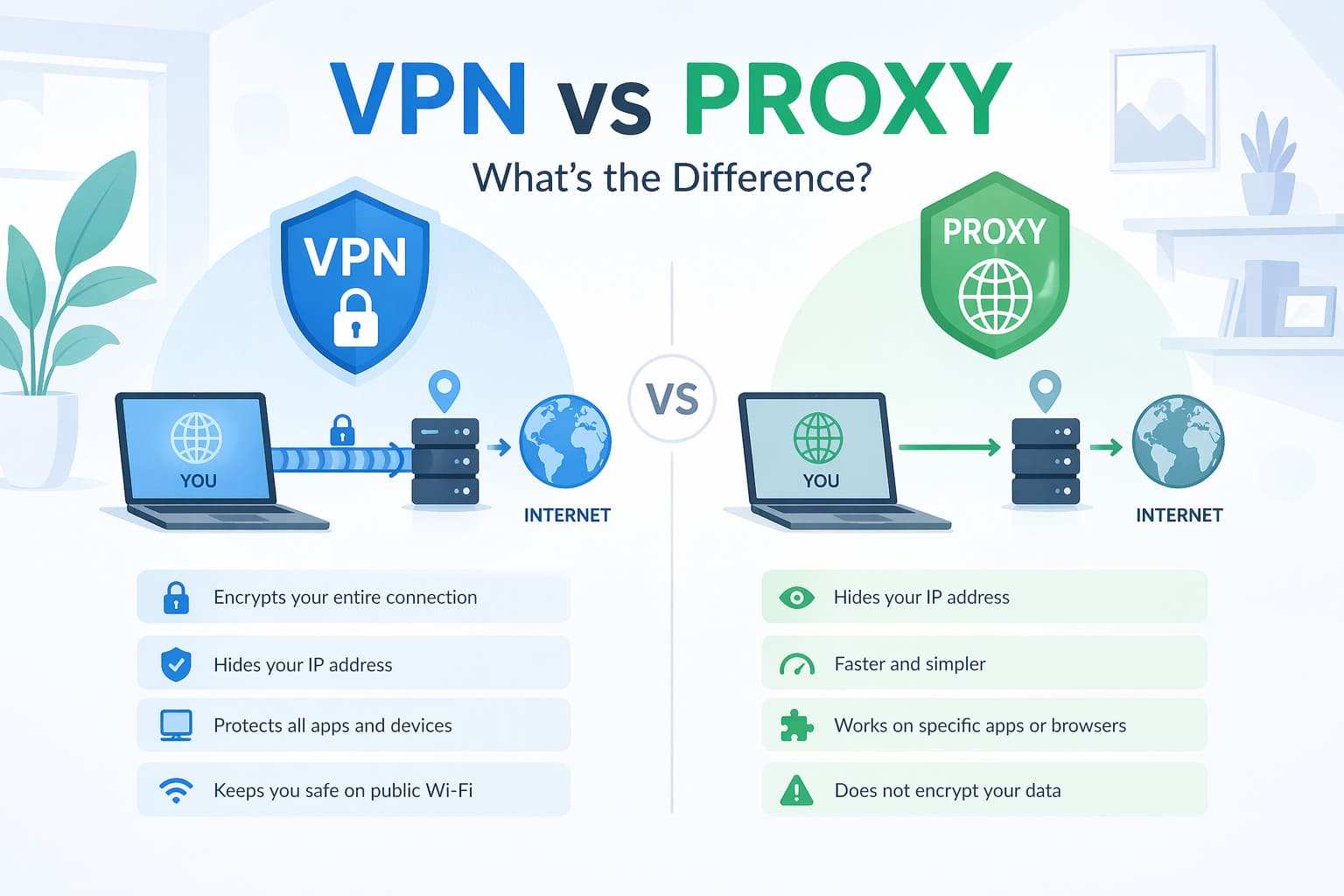
If you’re trying to understand what is a vpn vs proxy is, you’re likely looking for a simple answer — which one should you actually use? Both tools can hide your IP address, but they solve very different problems. One focuses on convenience, the other on protection. Choosing the wrong one can leave your data exposed without you realizing it.
Let’s break it down in a way that actually makes sense in real life — not in technical terms.
What a proxy really does when you use it
Before comparing tools directly, it’s important to understand how a proxy behaves during normal browsing. Most people don’t use proxies as standalone apps. Instead, they work inside a browser or a specific program.
A proxy acts like a relay point. Your request goes through it, and then it forwards that request to the website.
Here’s how that feels in practice:
- 🌍 Websites see a different IP address
- ⚡ Connection may feel slightly faster
- 🧩 Only part of your traffic is affected
- ❗ Your data is still visible in many cases
Because proxies don’t encrypt traffic, they don’t protect sensitive actions. Logging into accounts or entering payment details through a proxy is basically the same as doing it without protection.
How a VPN changes your internet behavior completely
Now let’s look at the other side of what is a proxy vs vpn. A VPN doesn’t just redirect traffic — it transforms how your connection works.
The moment you turn it on, your entire internet activity passes through an encrypted channel. Not just your browser — everything.
What changes instantly:
- 🔒 Data becomes unreadable to outsiders
- 📡 Your real location is replaced everywhere
- 💻 All apps use the secure connection
- 🛡 Public Wi-Fi becomes much safer
Instead of simply masking your IP, a VPN creates a secure environment for everything you do online. That’s why it’s considered a core privacy tool in 2026.
What is a VPN vs proxy: the real difference that matters
At this stage, understanding what is a vpn vs proxy is becomes critical, because the difference between a vpn proxy setup and a VPN directly affects your safety and experience.
Here’s the clear comparison:
Proxy:
- Works on app level, not system-wide
- Doesn’t encrypt your data
- Faster in basic tasks
- Limited privacy
VPN:
- Protects all traffic automatically
- Uses strong encryption (AES-256 standard)
- Slight speed impact (usually 10–20%)
- Full privacy and data protection
So while both tools change your visible location, only one actually protects what you’re doing.
Where proxies still make sense
Despite limitations, proxies are not useless. In fact, they are still widely used in specific situations where security is not critical.
A proxy works well when:
- You check how a site looks in another country.
- You need quick access without installing software.
- You automate tasks (for example, data scraping).
- You don’t handle personal or sensitive data.
For example, marketers often use proxies to test ads across regions. In this case, speed matters more than security.
When a VPN becomes the smarter choice
Now let’s talk about real-world usage. Modern internet behavior has changed. People don’t just browse anymore — they work, pay, and store personal data online.
This is where a VPN becomes essential.
Use a VPN when:
- ☕ You connect to public Wi-Fi
- 💳 You enter passwords or payment details
- 🌍 You travel and need stable access
- 👀 You want to reduce tracking
According to cybersecurity reports in 2026, over 70% of data leaks happen on unsecured networks. This is exactly where proxies fail, and VPNs succeed.
Speed myths and what you’ll actually experience
Many users hesitate because they think VPNs slow everything down. That used to be true years ago, but modern services have improved significantly.
Here’s what happens today:
- VPN speed loss is typically 10–20%
- Proxies can be slightly faster, but less stable.
- Good VPN servers keep streaming smooth.
In real usage:
- Videos still load without buffering.
- Websites open normally.
- Apps work as usual.
So the difference exists, but it’s rarely noticeable unless your base internet is already slow.
Mistakes that cost you privacy
Even after understanding vpn vs proxy, users often make decisions that cancel out any benefit.
Common problems:
- Using a proxy on public Wi-Fi
- Trusting random free tools
- Ignoring encryption completely
- Thinking IP masking equals security
👉 Tip: If your goal includes privacy even at a basic level, a proxy is not enough.
Simple way to decide between VPN and proxy
Instead of overthinking, use this quick logic:
Choose a proxy if:
- You need speed for simple tasks.
- You don’t share personal data.
Choose a VPN if:
- You care about security.
- You use open networks.
- You want consistent protection.
For most people today, a VPN fits better because internet usage involves more risk than before.
What is a VPN vs proxy in real life
Understanding what is a vpn vs proxy is not about technology — it’s about control. You decide how much of your data is visible and how safe your connection is.
A proxy is a quick workaround. A VPN is a long-term solution.
If you only need to change location, a proxy might be enough. If you want real privacy and protection, a VPN is the safer and more reliable choice.
👉 The easiest way to see the difference is to try both. But once you use a VPN on public Wi-Fi, going back feels like removing a safety layer you didn’t realize you needed.